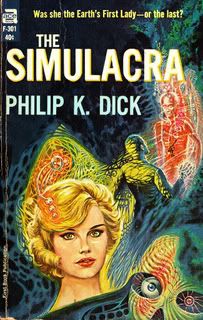
Jesse writes with explosive allegations concerning the sci-fi giant Philip K. Dick and his greatest work:
In September 1961, DC Comics issued the landmark Flash #123, “Flash of Two Worlds,” written by Gardner Fox. On the cover are not one but two Flashes, both running to save a man about to be crushed by a falling girder. On the left is the Flash of the Silver Age of Comics (roughly 1956 to the late ’60s/early ’70s), the one we are perhaps most familiar with today. On the right is the Golden Age Flash (1930s to 1951), who does not wear a mask, but instead has a silver helmet like the god Mercury. The Golden Age Flash had not been seen since 1951, when the Justice Society of America comic was discontinued because of lagging sales. Many superhero comics were canceled at this time to make way for grittier war, horror and detective titles. The Silver Age is said to have begun with the Flash’s rebirth in 1956, and by 1961, with the return of the Justice League of America, the Silver Age and the revival of superhero comics was in full swing.
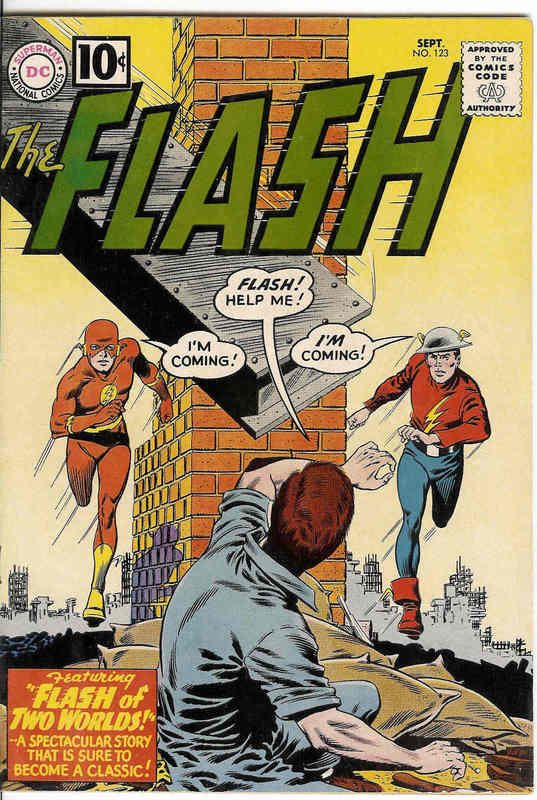
Confused? This new Flash had a different origin story and identity: once known as Jay Garrick, the Flash post-1956 had the alter ego of Barry Allen. This Flash also lived in a different city. The older, canceled Flash and other defunct heroes were never discussed in the new comics: continuity in a “DC Universe” was not an issue yet. These were comics for kids — who cared?
So what were both Flashes doing on the cover?
The story relates how one day, while vibrating at a super speed, the Flash of the Silver Age is transported to a parallel Earth. Things there are somewhat similar, though with small, unsettling differences like city names. Think Jimmy Stewart in It’s A Wonderful Life, when he wishes he never existed.
This is of course not the first alternate history/world in fiction. An important precedent is the Nathaniel Hawthorne story “P.’s Correspondence,” from 1845, in which one “P.” details the lives of famous poets of the past who remain alive in some other world. This is considered the first alternate history story in English and I believe it is what gave Philip K. Dick the name of his character Hawthorne Abendsen in The Man in the High Castle. In that novel, Dick’s breakthrough and still one of his most famous books, the Axis powers won World War II and have divided most of the former United States, while a banned book by Abendsen, called The Grasshopper Lies Heavy, tells what the world would be like had the Allies won.
In Flash #123, after being confronted with an alternate reality, Barry Allen has a brainstorm: “Could it be that — what I’m thinking — is true? ‘He’ used to live there!” He finds a telephone book and looks up the name JAY GARRICK, the Golden Age Flash. “My theory — impossible as it seems — must be true!” he says. He goes to the address and there, sure enough, is the original Flash, aged. Allen relates to Garrick the first Flash’s origin story, at which the older man is greatly surprised. “How could he possibly know all that?” Garrick exclaims to his wife. “We were sure we’d kept that secret so well! How did he find out?” she replies.
This is where it really gets interesting. Silver Age Flash tells his own origin story, ending with the following:Silver Age Flash: “So you see, I became the Super Fast Flash on my Earth much as you became the the Flash on yours! Indeed, reading of your Flash adventures inspired me to assume the secret identity of the Flash!”
Golden Age Flash: “What?! How did you ever read about ME?”
Silver Flash: “You were once well known in my world — as a fictional character appearing in a magazine called Flash comics! When I was a youngster — you were my favorite hero! A writer named Gardner Fox wrote about your adventures — which he claimed came to him in dreams! Obviously when Fox was asleep, his mind ‘tuned in’ on your vibratory Earth! That’s how he ‘dreamed up’ the Flash! The magazine was discontinued in 1949!”
Golden Age Flash: “Amazing! That’s the very year I — the Flash — retired...”
A couple things here. Recall that Fox is the writer of the comic we are reading (as well as the author of the original Flash). Also, the Golden Age Flash, the one Barry Allen read about as a kid, would have been the one Dick read as a kid; he was 12 when the original appeared. Finally, the story of Fox “tuning in” this Earth is remarkably similar to Dick’s own strange series of visions of “2-3-74,” which he later wrote about in his books VALIS and Radio Free Albemuth.
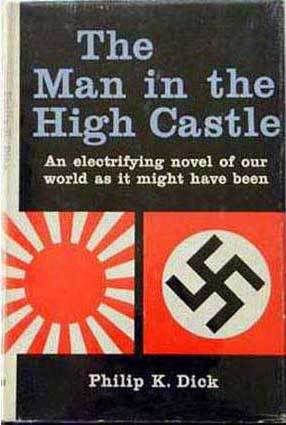 At the end of the Flash story, once the Silver Age hero has returned to his own world, he explains how he is going to tell this tale: “The only ones who’d really believe it would be the readers of FLASH comics! That’s why I’m going to look up Gardner Fox who wrote the original FLASH stories and tell it to him! He can write the whole thing in a comic book.” This establishes yet a third world — ours. Like the story of The Grasshopper Lies Heavy. So:
- Us reading the Flash comic = Us reading The Man in the High Castle
- Silver Age Flash reading the original Flash comics = The characters in The Man in the High Castle reading Grasshopper
- The Golden Age Flash = The characters in Grasshopper
This issue of the Flash was a landmark for DC. It established the “multiverse” idea that would be used over and over again, and set up continuity conflicts that would be settled decades later in Crisis on Infinite Earths. In 2004, a copy sold at auction for $23,000.
It is entirely possible that Dick would have picked this comic up, especially since the cover is adorned with the Flash of his childhood. Remember, this came out in September 1961. According to Wikipedia, The Man in the High Castle was published in January 1962, although other sites list it somewhat later. I could not find any information about when it was submitted, nor when it was written. One site says it came out in October 1962. Still, it definitely came out after the comic. [See note on chronology below. — Ed.]
One hole in Jesse’s argument: If Dick did “rip off” anything for The Man in the High Castle, a more prominent candidate would be George Orwell’s 1984. In it, the main character, Winston Smith, is given a secret book called The Theory and Practice of Oligarchical Collectivism that tells the political crimes of Big Brother and the ruling party. Like The Grasshopper Lies Heavy, it is a banned book-within-a-book that reveals a contrary narrative to the one being imposed on society by a totalitarian government, and inspires the protagonist to act.
The difference, of course, is that Oligarchical Collectivism — also referred to in 1984 simply as “The Book” — is supposed to be a work of nonfiction, while Grasshopper is described as fiction. (In the comics, the story of the Golden Age Flash was at first believed to be fiction, but then discovered to be true.)
About chronology, note that in comic books, the cover date is often months later than it became available. This goes back to the earliest days, and publishers did it to insure a longer shelf-life for their products, so that they would “look new” for longer.
Also note: Jesse is currently unemployed. (But I am not — who’s more pathetic?)