Friday, September 12, 2008
Thursday, September 11, 2008
Mapping Girl Talk samples
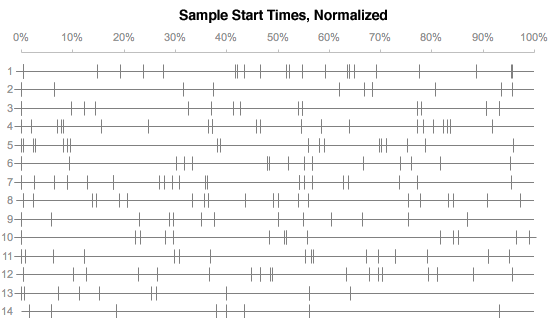
Andy Baio at Waxy.org has done an impressive number-crunching job with the 264 samples on Girl Talk’s album Feed the Animals.
Using Wikipedia data and Amazon.com’s crowdsourcing program Mechanical Turk, he charted out exactly what moment each sample appears on the songs, graphically illustrating the spacing and density of samples on the record. It’s pretty dense — out of 14 tracks, the average number of samples per track, Baio says, is 19.8. (Though I don’t totally understand that computation: 264 divided by 14 is 18.9; maybe it’s a typo.)
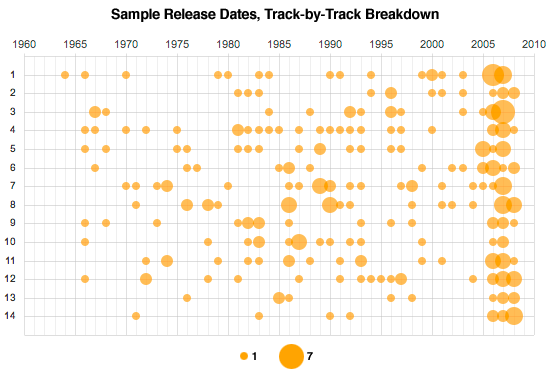
Other interesting visual aids show how old each of the samples are across Feed the Animals. They stretch back to the mid-’60s but most are very recent:
Very impressive work, though it’s not a big surprise given Baio’s record: on two posts in May, he did some incredible data-mining in the Billboard singles charts, looking at the track length of Top 40 songs over the last 50 years as well as the staying power of one-hit wonders. Highly recommended reading, and not just for people like me who already spend too much time reading pop charts.
In related news, Sasha Frere-Jones wrote in the New Yorker this week about laptop music, and he talked to Gregg Gillis (a.k.a. Girl Talk) about how he does the show live. It’s very labor intensive: “To perform a live set, Gillis has to turn a new loop on and off every few seconds, or choose to let several go on longer if he feels like getting up and dancing. The software is not set up to execute a long, complicated series of decisions on his behalf. He has to re-create the mix every night.”
1 comments
Labels:
audio,
data crunching,
girl talk,
visual aids

Wednesday, September 10, 2008
Tuesday, September 9, 2008
Museum of propaganda: Moaist children’s music

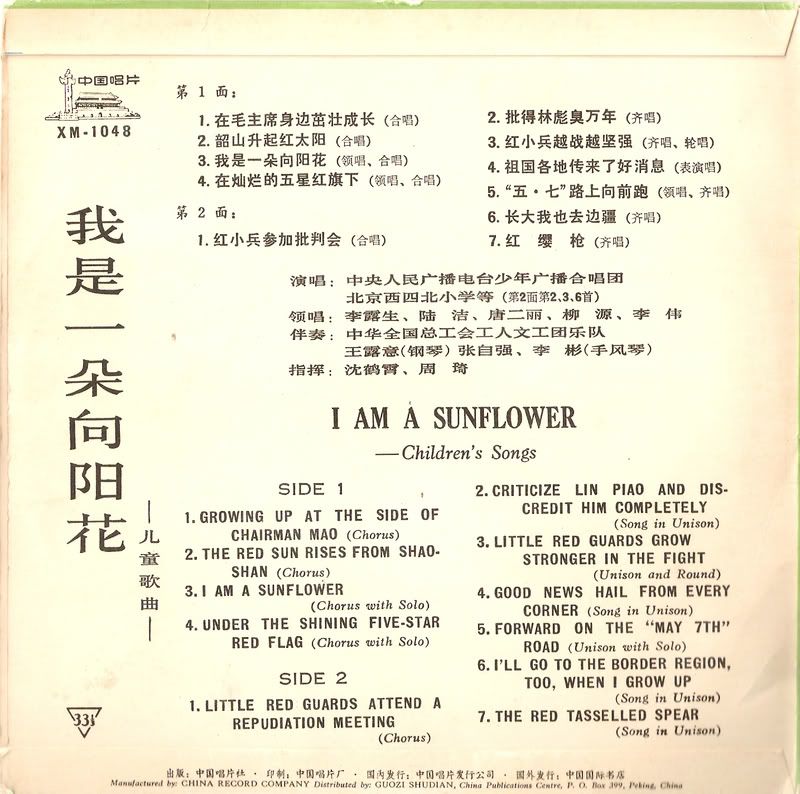
“Yeah, growing up I was never much into the big corny radio hits, you know, like ‘Criticize Lin Piao and Discredit Him Completely.’ I was more into the deep cuts. ‘Under the Shining Five-Star Red Flag’; ‘Little Red Guards Attend a Repudiation Meeting’ — that one really kicked my ass!”
(Via LP Cover Lover.)
0
comments
Labels:
china,
propaganda

Monday, September 8, 2008
Museum of propaganda: ‘Imperial appetites’
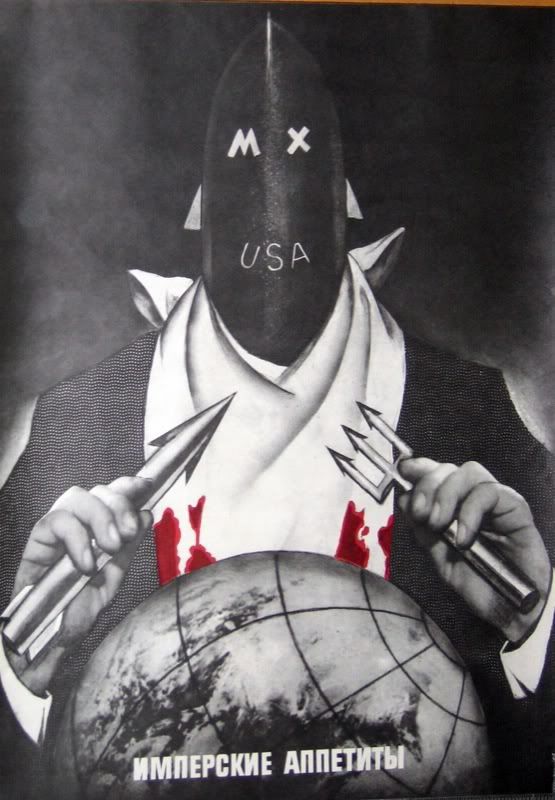
Russian, 1985.
0
comments
Labels:
posters,
propaganda,
russia
Saturday, September 6, 2008

Friday, September 5, 2008
Museum of propaganda, literally
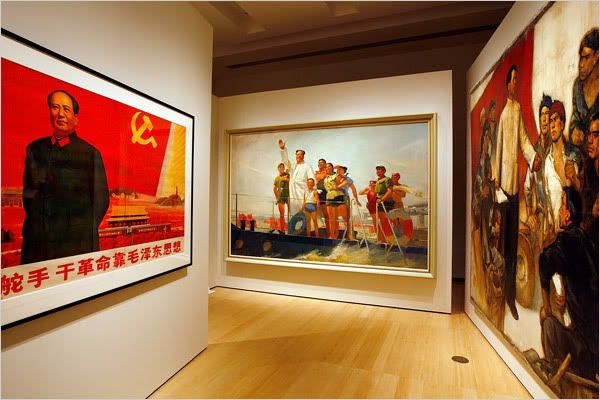
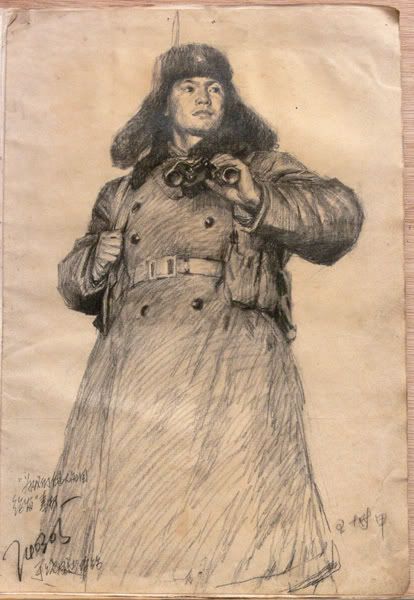
What looks like a wonderful show on Chinese propaganda art, which has become one of my favorite topics, opens today at the Asia Society in Manhattan. I bought a bunch of these posters in China last year — there are cheap reproductions of Cultural Revolution-era prints available from street vendors all over tourist Beijing — and have been reading about the phenomenon in books by Steven Heller and others. (One day I’ll get around to posting images of the posters I picked up, but it’s so much easier to just let other people do all the scanning work. I don’t even know how, really.)
Holland Cotter, who went to China recently and has been writing up a storm about it, reviewed the show in the Times today. The press release for the exhibition lists a lot of interesting lectures, films and other public programs too. Looking forward to it.
0
comments
Labels:
china,
posters,
propaganda
New Webb Brothers track
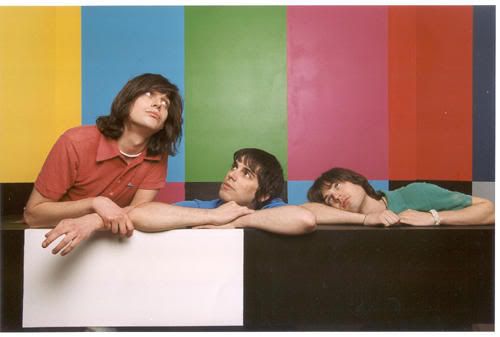
And it’s about time!
I don’t usually go for superlative hypes like “the greatest band you’ve never heard,” but if I did, one band I would certainly apply it to would be the Webb Brothers. These two (now three) sons of the songwriter Jimmy Webb released three marvelously epic, weary, druggy albums from 1999 to 2003. Maroon, which was released in the U.K. in 2000 and here in 2001, is the masterpiece, the pop-rock tragicomedy that Oasis never had the brains or sensitivity (or vocals) to make.
(The Webbs’ other albums are worth seeking out: Beyond the Biosphere in 1999, and a self-titled one in 2003.)
It’s been five long years of spotty web updates and unfulfilled album promises, but the band has finally posted a new song to MySpace, “Break Out the Sunshine.” Not clear when it went up, but comments suggest early August.
The boys are originally from Chicago, and spent time in London during the Maroon era. Now Christiaan, Justin and James Webb are based in L.A., and “Break Out the Sunshine” is a moody California dream piece à la Dennis Wilson. On the first few listens it didn’t kill me the way older songs like “I Can’t Believe You’re Gone” and “Who Wants to Get High?” did, but it’s classic Webb Brothers, wistful and histrionic and deceptively simple.
Their Wikipedia page says they’re working on a new album called The God Helmet. Please don’t make me wait another five years, guys.
1 comments
Labels:
audio,
reviews,
webb brothers
Thursday, September 4, 2008
Did Philip K. Dick rip off a Flash comic for The Man in the High Castle?
Jesse writes with explosive allegations concerning the sci-fi giant Philip K. Dick and his greatest work:
In September 1961, DC Comics issued the landmark Flash #123, “Flash of Two Worlds,” written by Gardner Fox. On the cover are not one but two Flashes, both running to save a man about to be crushed by a falling girder. On the left is the Flash of the Silver Age of Comics (roughly 1956 to the late ’60s/early ’70s), the one we are perhaps most familiar with today. On the right is the Golden Age Flash (1930s to 1951), who does not wear a mask, but instead has a silver helmet like the god Mercury. The Golden Age Flash had not been seen since 1951, when the Justice Society of America comic was discontinued because of lagging sales. Many superhero comics were canceled at this time to make way for grittier war, horror and detective titles. The Silver Age is said to have begun with the Flash’s rebirth in 1956, and by 1961, with the return of the Justice League of America, the Silver Age and the revival of superhero comics was in full swing.
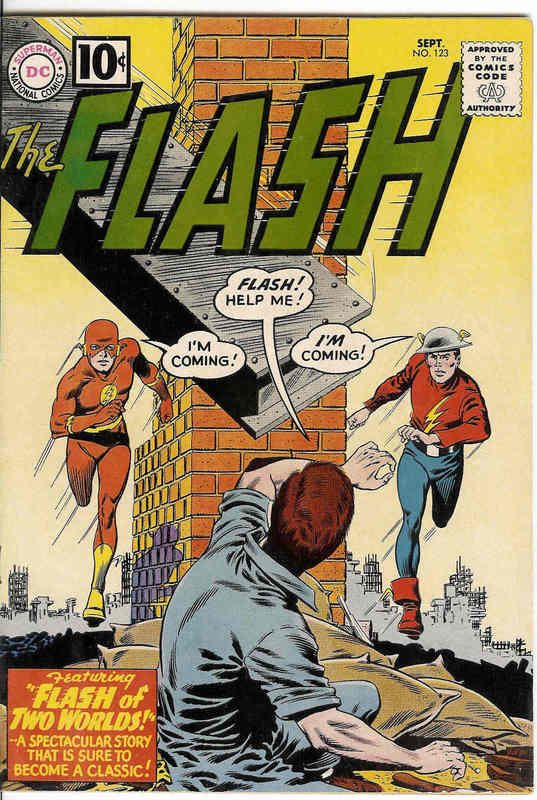
Confused? This new Flash had a different origin story and identity: once known as Jay Garrick, the Flash post-1956 had the alter ego of Barry Allen. This Flash also lived in a different city. The older, canceled Flash and other defunct heroes were never discussed in the new comics: continuity in a “DC Universe” was not an issue yet. These were comics for kids — who cared?
So what were both Flashes doing on the cover?
The story relates how one day, while vibrating at a super speed, the Flash of the Silver Age is transported to a parallel Earth. Things there are somewhat similar, though with small, unsettling differences like city names. Think Jimmy Stewart in It’s A Wonderful Life, when he wishes he never existed.
This is of course not the first alternate history/world in fiction. An important precedent is the Nathaniel Hawthorne story “P.’s Correspondence,” from 1845, in which one “P.” details the lives of famous poets of the past who remain alive in some other world. This is considered the first alternate history story in English and I believe it is what gave Philip K. Dick the name of his character Hawthorne Abendsen in The Man in the High Castle. In that novel, Dick’s breakthrough and still one of his most famous books, the Axis powers won World War II and have divided most of the former United States, while a banned book by Abendsen, called The Grasshopper Lies Heavy, tells what the world would be like had the Allies won.
In Flash #123, after being confronted with an alternate reality, Barry Allen has a brainstorm: “Could it be that — what I’m thinking — is true? ‘He’ used to live there!” He finds a telephone book and looks up the name JAY GARRICK, the Golden Age Flash. “My theory — impossible as it seems — must be true!” he says. He goes to the address and there, sure enough, is the original Flash, aged. Allen relates to Garrick the first Flash’s origin story, at which the older man is greatly surprised. “How could he possibly know all that?” Garrick exclaims to his wife. “We were sure we’d kept that secret so well! How did he find out?” she replies.
This is where it really gets interesting. Silver Age Flash tells his own origin story, ending with the following:Silver Age Flash: “So you see, I became the Super Fast Flash on my Earth much as you became the the Flash on yours! Indeed, reading of your Flash adventures inspired me to assume the secret identity of the Flash!”A couple things here. Recall that Fox is the writer of the comic we are reading (as well as the author of the original Flash). Also, the Golden Age Flash, the one Barry Allen read about as a kid, would have been the one Dick read as a kid; he was 12 when the original appeared. Finally, the story of Fox “tuning in” this Earth is remarkably similar to Dick’s own strange series of visions of “2-3-74,” which he later wrote about in his books VALIS and Radio Free Albemuth.
Golden Age Flash: “What?! How did you ever read about ME?”
Silver Flash: “You were once well known in my world — as a fictional character appearing in a magazine called Flash comics! When I was a youngster — you were my favorite hero! A writer named Gardner Fox wrote about your adventures — which he claimed came to him in dreams! Obviously when Fox was asleep, his mind ‘tuned in’ on your vibratory Earth! That’s how he ‘dreamed up’ the Flash! The magazine was discontinued in 1949!”
Golden Age Flash: “Amazing! That’s the very year I — the Flash — retired...”At the end of the Flash story, once the Silver Age hero has returned to his own world, he explains how he is going to tell this tale: “The only ones who’d really believe it would be the readers of FLASH comics! That’s why I’m going to look up Gardner Fox who wrote the original FLASH stories and tell it to him! He can write the whole thing in a comic book.” This establishes yet a third world — ours. Like the story of The Grasshopper Lies Heavy. So:
This issue of the Flash was a landmark for DC. It established the “multiverse” idea that would be used over and over again, and set up continuity conflicts that would be settled decades later in Crisis on Infinite Earths. In 2004, a copy sold at auction for $23,000.
- Us reading the Flash comic = Us reading The Man in the High Castle
- Silver Age Flash reading the original Flash comics = The characters in The Man in the High Castle reading Grasshopper
- The Golden Age Flash = The characters in Grasshopper
It is entirely possible that Dick would have picked this comic up, especially since the cover is adorned with the Flash of his childhood. Remember, this came out in September 1961. According to Wikipedia, The Man in the High Castle was published in January 1962, although other sites list it somewhat later. I could not find any information about when it was submitted, nor when it was written. One site says it came out in October 1962. Still, it definitely came out after the comic. [See note on chronology below. — Ed.]
One hole in Jesse’s argument: If Dick did “rip off” anything for The Man in the High Castle, a more prominent candidate would be George Orwell’s 1984. In it, the main character, Winston Smith, is given a secret book called The Theory and Practice of Oligarchical Collectivism that tells the political crimes of Big Brother and the ruling party. Like The Grasshopper Lies Heavy, it is a banned book-within-a-book that reveals a contrary narrative to the one being imposed on society by a totalitarian government, and inspires the protagonist to act.
The difference, of course, is that Oligarchical Collectivism — also referred to in 1984 simply as “The Book” — is supposed to be a work of nonfiction, while Grasshopper is described as fiction. (In the comics, the story of the Golden Age Flash was at first believed to be fiction, but then discovered to be true.)
About chronology, note that in comic books, the cover date is often months later than it became available. This goes back to the earliest days, and publishers did it to insure a longer shelf-life for their products, so that they would “look new” for longer.
Also note: Jesse is currently unemployed. (But I am not — who’s more pathetic?)
5
comments
Labels:
comics,
grand theories,
philip k. dick,
reviews
Wednesday, September 3, 2008
Subscribe to:
Posts (Atom)