Showing posts with label visual aids. Show all posts

Thursday, August 20, 2009

Harrison ‘My Wife! My Family!’ Ford

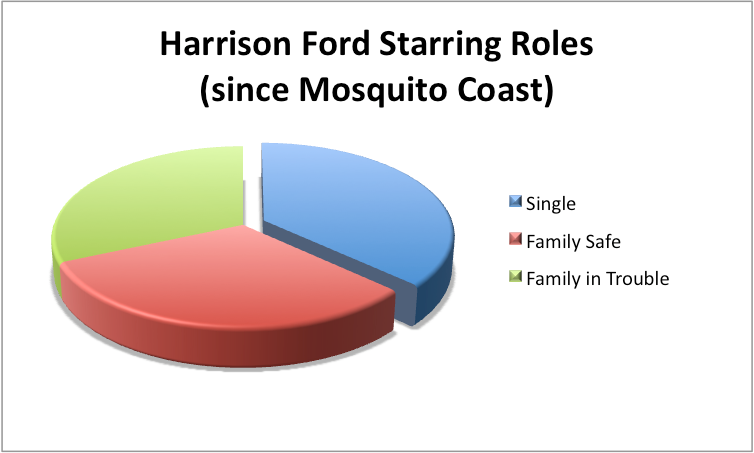
Absolutely fucking brilliant analysis of Harrison Ford films today by Jake and Jesse, with the help, apparently, of somebody on YouTube who compiled scenes from various movies showing the former intergalactic skirt-chaser fuming over his lost/kidnapped/killed/whatever wife and family, over and over and over and over.


The tipping point, our boys argue, came with The Mosquito Coast.

Photobucket

Read Jake’s full post here. Good work, guys.

Wednesday, March 25, 2009

West 24th Street

Photobucket

‘How China sees the world’

Brilliant Economist cover by Jon Berkeley, whose note above the Forbidden City (barely visible on this scan) reads: “With apologies to Steinberg and the New Yorker.”


Photobucket

The funny thing is that Chang’an and Dongdan are two of the only street names I remember from Beijing.

(Via Strange Maps.)

Wednesday, December 24, 2008

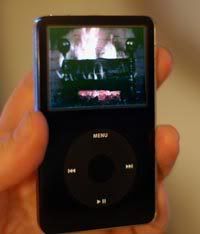
’Tis the season to download the WPIX Yule Log for iPod

Photobucket

Alessandra Stanley’s column today about video yule logs reminded me to remind the world that the great WPIX Yule Log — the original — is available as a download for your iPod.

Which means that while you’re waiting on line at the airport or being shoved in the face by someone’s luggage on an Amtrak train, you can find comfort in 240 by 180 crackling pixels on a 6 minute 3 second loop.

And although classic WPIX remains the greatest television station ever — two words: Phil Rizzuto — I learned this year that even we New York chauvinists can reach to our friends across the country in Yule Log solidarity. It was filmed in a house in California on a hot August day in 1970.

Something to chat about over your wassail games this year.

Friday, December 19, 2008

Reading Reed, Reed reading

Photobucket

Saw Lou Reed the other night at the Housing Works Bookstore Café in SoHo, reading from his new collection of lyrics, Pass Thru Fire.

Like everything Reed does, it was amazing and perplexing. When he didn’t look bored, he looked wounded; when he didn’t look wounded, he was angry, physically so — the crowd was told that flash photography was forbidden, and when some poor schmuck snapped him with flash at close range, Lou slammed his fist in rage.

He’s constantly slipping between emotional extremes, on the one hand aloof and cynical, on the other vulnerable and coiled like a snake. When he performed Berlin in Brooklyn two years ago, I couldn’t take my eyes off his face: such numbness and yet such pain. You can see it in Tony Cenicola’s wonderful portrait of him that accompanied my interview with Reed for that show. I was jealous; I hadn’t even come close to cracking that shell.

Nor will I ever, and nor will you. Because perhaps the most important part of his persona is something that I realized was the answer to one of the questions put by the Housing Works audience. (They couldn’t ask directly — the mere mortals had to write their questions down on slips of paper, to be asked later by Alan Light, whose expression upon being shot down by Reed’s gruff answers was priceless.)

The question was, “What’s your secret to being cool?” He’s a pro, so he made some pithy joke, and he got his laugh. But the real answer is: Be an asshole. Be superior, be indifferent, be too self-absorbed to care about anyone else, but then lash out. Show gratuitous anger. Show that the slightest thing that other people do can piss you off — that their very existence pisses you off. That’s how to be cool, and it’s why no one will ever be cool the way Lou Reed is cool.

But enough about that.

Pass Thru Fire. Not impressive, for several reasons. Not because of the literary content — though Reed himself seemed barely interested as he read his own words, two or three of the songs, especially “Rock Minuet,” froze me.

What’s irritating is that the book is one more bit of redundant catalog exploitation, and it’s sloppily done, too. By my count this is Reed’s fourth book of lyrics. It follows Between Thought and Expression: Selected Lyrics of Lou Reed, which I got for Christmas in 1991; The Raven, from 2003, which is the lyrics to POEtry, Reed’s “disjointed gray mass” of a theater piece, after Edgar Allan Poe; and the previous edition of Pass Thru Fire, from 2002. The new edition adds about 100 pages, with The Raven and a short section called “The Latest.”

And that’s just the books. This is the guy whose music has been compiled, boxed and otherwise repackaged at least 12 times in the U.S. (and still more overseas): Walk on the Wild Side: The Best of Lou Reed (1977), Vicious (1979), Rock and Roll Diary: 1967-1980 (1980), City Lights (1985), Walk on the Wild Side & Other Hits (1992), Between Thought and Expression: The Lou Reed Anthology (1992), The Best of Lou Reed & the Velvet Underground (1995), Different Times: Lou Reed in the ’70s (1996), The Definitive Collection (1999), NYC Man: The Collection (2003), Platinum & Gold Collection (2004), and Playlist: The Very Best of Lou Reed (2008). (Only one of these is really essential: Rock and Roll Diary, with definitive liner notes by Ellen Willis.)

Plus eight live albums: Rock n Roll Animal (1974), Lou Reed Live (1975), Live: Take No Prisoners (1978), Live in Italy (1984), Perfect Night: Live in London (1998), American Poet (2001), Animal Serenade (2004), and Berlin: Live at St. Ann’s Warehouse (2008).

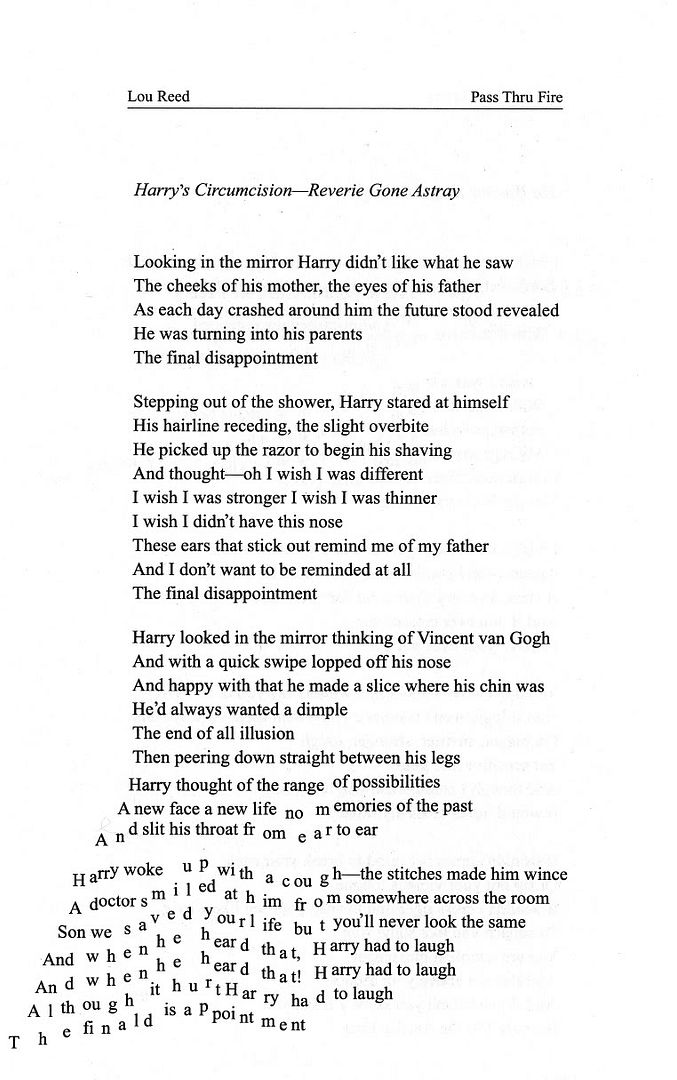
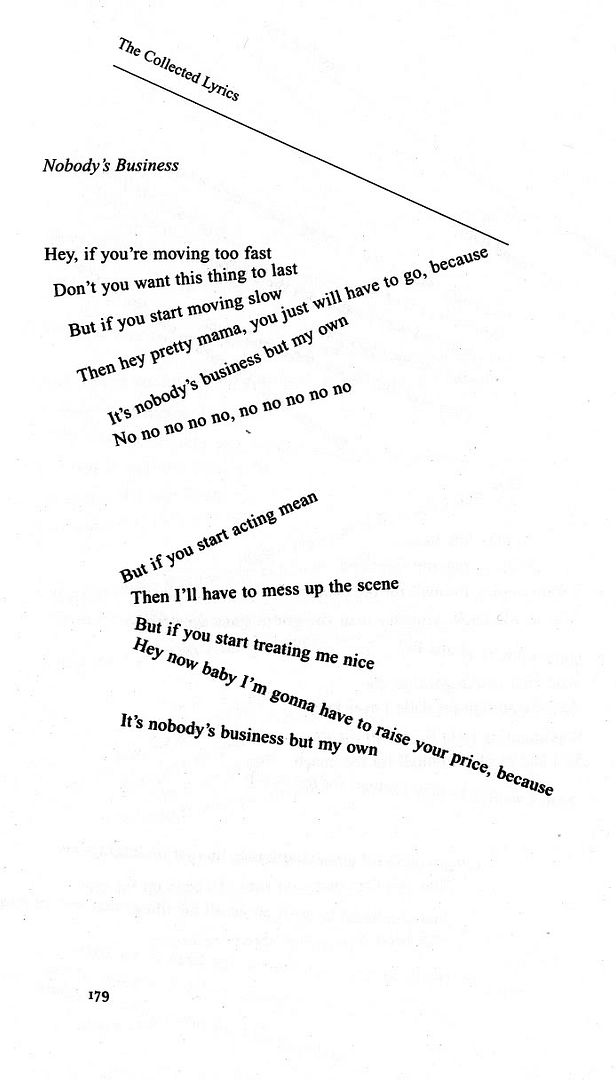
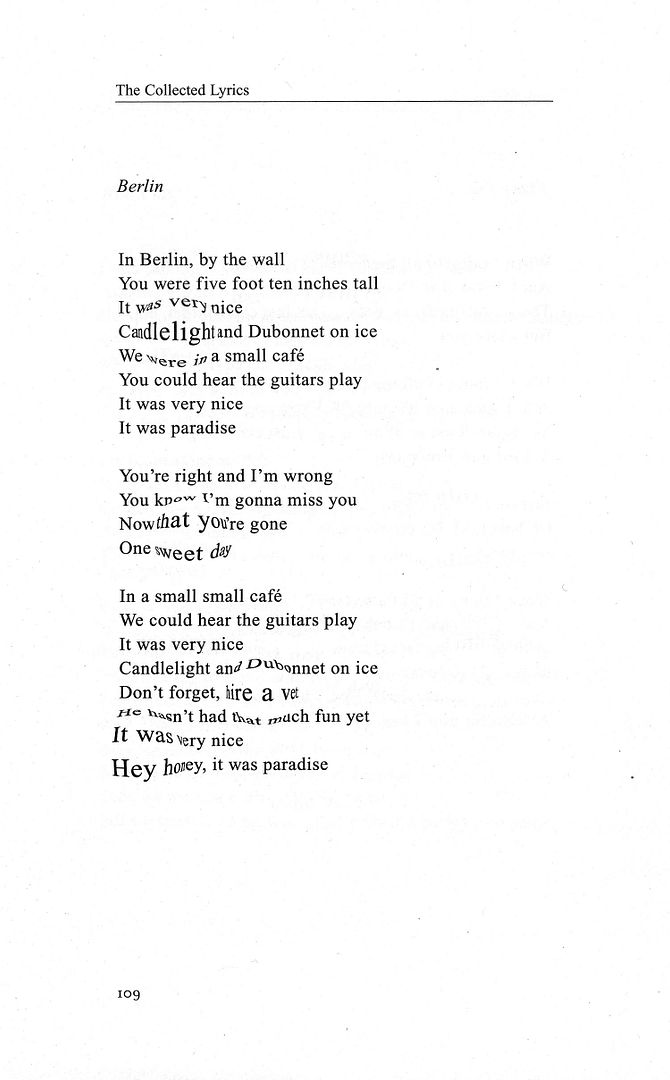
Who knows how much of this clutter Reed himself can be blamed for, and how much is the cheap and greedy work of anonymous label executives over the years. But there’s no excuse for the book, which was laid out as though the designer had just gotten his first copy of QuarkXPress and was dying to show off that he new how to add smudges and wavy lines to the text, and have it all line up in a circle pattern and then fall apart, etc., etc.; if you saw a copy of Ray Gun in 1993, you’ve seen it all. But it’s more than dated, and it’s beyond gimmicky. It’s idiotic, tasteless and even disrespectful — to his own work.

Here are a few pages from the book. These are not doctored and are not scanner mistakes — this is really the way it was designed. Lou, how could you. Is it just so that you can release The Ultimate Pass Thru Thought and Expression Collection, Velvet Edition in 2013?

PhotobucketPhotobucketPhotobucket

Tuesday, October 28, 2008

Amazing ‘Album Atlas’

Photobucket


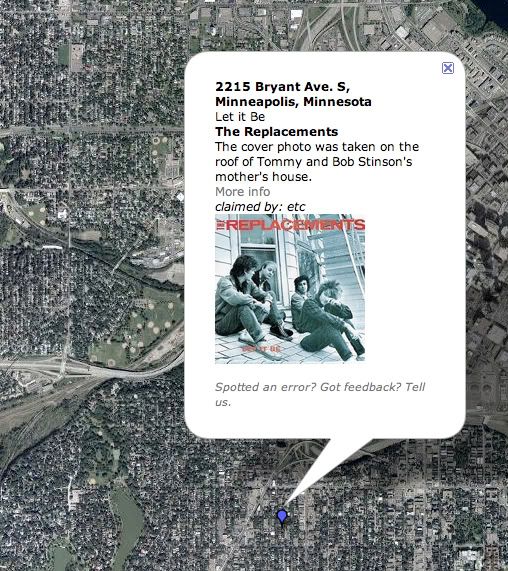
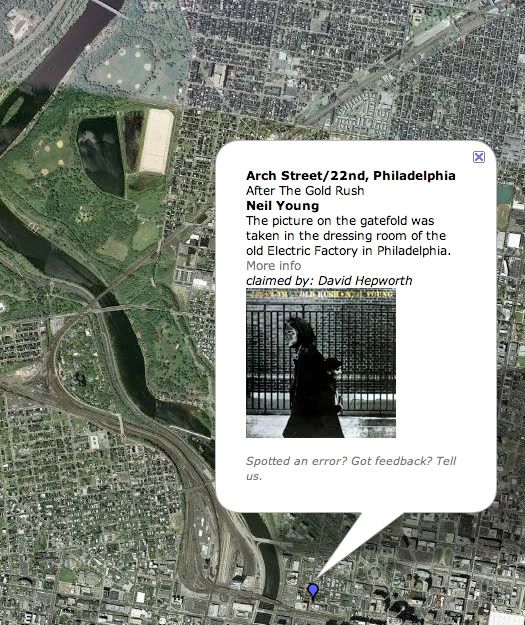
The Word, a British music magazine that I have to admit I don’t read very often, has a wonderful web feature called Album Cover Atlas. It’s a Google Map that pinpoints where classic album cover photos were taken. Some are self-evident, of course, like Abbey Road or Live at the Apollo. But I had no idea that Kiss’s Dressed to Kill was shot a block from my house, nor would I likely ever find Phetchaburi Road in Bangkok, where the Clash apparently stood for Combat Rock. Thanks, The Daily Swarm, for pointing this out.

Other neat ones: Teenage Fanclub, Songs From Northern Britain (Aviemore, indeed way up in the Scottish Highlands); the Kinks, Muswell Hillbillies (the Archway Tavern, on a little island in the middle of a major highway in London*). Least interesting: Dave Matthews albums, which are in obvious and/or famous locations like Radio City Music Hall, Red Rocks, Charlottesville, the Gorge.

You can contribute to the project yourself, and so far there are about 600 entries. That sounds like a lot, but spread over the entire planet that leaves lots of unannotated terrain. Can’t wait to see all the dots on the map of say, Manhattan or London once this hits a critical mass.


Photobucket


* Years ago I saw a short documentary about the making of the album. Muswell Hill was where Ray and Dave Davies were born, and in the film Ray complained about the bulldozing and gentrification of what had been a working-class area with lots of salt-of-the-earth pubs like the one pictured.

Thursday, September 11, 2008

Mapping Girl Talk samples

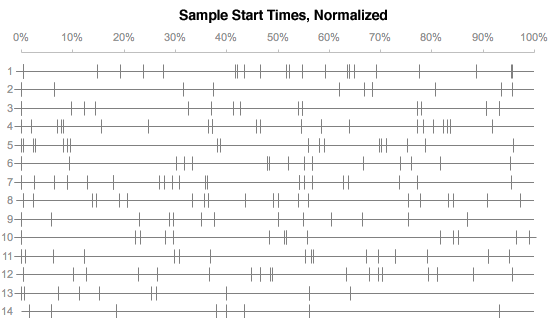
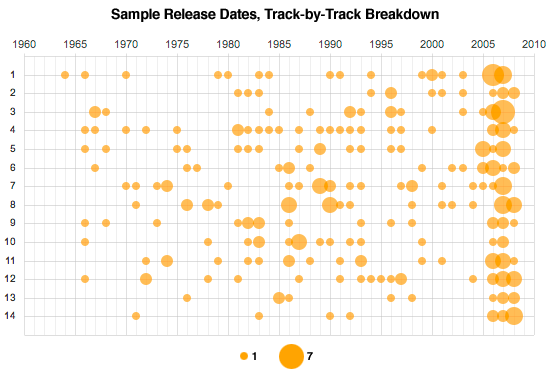
Andy Baio at Waxy.org has done an impressive number-crunching job with the 264 samples on Girl Talk’s album Feed the Animals.

Using Wikipedia data and Amazon.com’s crowdsourcing program Mechanical Turk, he charted out exactly what moment each sample appears on the songs, graphically illustrating the spacing and density of samples on the record. It’s pretty dense — out of 14 tracks, the average number of samples per track, Baio says, is 19.8. (Though I don’t totally understand that computation: 264 divided by 14 is 18.9; maybe it’s a typo.)

Other interesting visual aids show how old each of the samples are across Feed the Animals. They stretch back to the mid-’60s but most are very recent:

Very impressive work, though it’s not a big surprise given Baio’s record: on two posts in May, he did some incredible data-mining in the Billboard singles charts, looking at the track length of Top 40 songs over the last 50 years as well as the staying power of one-hit wonders. Highly recommended reading, and not just for people like me who already spend too much time reading pop charts.

In related news, Sasha Frere-Jones wrote in the New Yorker this week about laptop music, and he talked to Gregg Gillis (a.k.a. Girl Talk) about how he does the show live. It’s very labor intensive: “To perform a live set, Gillis has to turn a new loop on and off every few seconds, or choose to let several go on longer if he feels like getting up and dancing. The software is not set up to execute a long, complicated series of decisions on his behalf. He has to re-create the mix every night.”

Monday, July 28, 2008

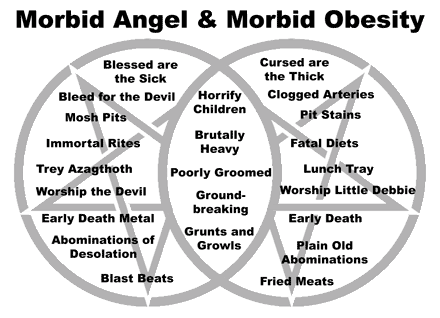
‘Venn Pentagram’

Brilliance from Deciblog on the overlap between a classic Florida death metal band and a disease that is costing untold sums in medical care and insurance premiums:

Photobucket

Monday, July 21, 2008

Watchin’ the Watchmen trailer

How I catch every production designer and costumer v-journal but miss the trailer, I don’t know. But thanks to a link from Jake, I now have seen it. In HD, too.

And ... I dunno. My initial reactions are all fanboy reflexes, which means they are uncritical and prejudicial and they emerge from deep within the mylar sleeves of my crocodile brain. Comedian is too handsome. Laurie/Silk Spectre is too sexy. Dan/Nite Owl isn’t fat enough. Veidt/Ozymandias is too young. Too this, too that. Not exactly like the comic. Worst episode ever.

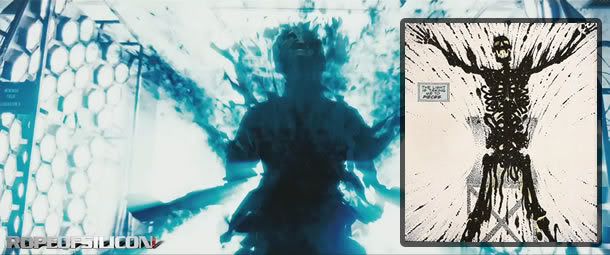
Which is unfair. The V for Vendetta film may have been a dumbed-down hatchet job, but it was a pretty good dumbed-down hatchet job. With Watchmen I’m bracing for the worst in terms of storyline and acting, but it’s clear from the trailer that a great deal of attention has been paid to production detail. We basically already knew that, but this confirms it. Rope of Silicon has a frame-by-frame, movie-to-comic comparison of some key scenes, revealing that yes, they look like reasonably faithful translations of certain images:

Photobucket

The big question is whether that is all they are. A story is more than props and a rigid storyboard. If anything, too much concern about making a xerox from one medium to another suggests a slavish uncreativity on the part of a director, a failure of imagination. Too often, I think, that is where comic adaptations go wrong: they get stuck in the small picture and miss the big picture.

With Watchmen the stakes are especially high because the big picture is very, very big. It’s the best story ever told in comics and one of the best in 20th-century literature, an artfully complex summation of late-Cold War politics and popular culture. That’s not just me talking: as is well known, it placed on Time magazine’s list a few years ago of the 100 best novels since 1923.

(Even though we live in an age of war, I think the paranoia and pessimism of Watchmen are essentially rooted in the Cold War and are no longer a part of our culture, at least not in the same way. For some reason, though, that makes it more real to me. This is not a vague and formulaic complaint about war and death in general; it’s about a time and a place. That makes it real history, and paradoxically also makes it more universal.)

The 2 minute 20 second trailer is not enough to decide whether the film meets the challenge. But it reveals something that for other comic adaptations has been a tell-tale flaw: the little details have been obsessively accounted for, from Nite Owl’s ship to Ozymandias’ collar to Rorschach’s Veidt-brand hair spray weapon. All that is nice, but it’s not enough. Does Zack Snyder know that? Who watches him?

(One thing that’s kind of funny: Apple’s page for the HD version of the trailer seems to mix up the names of some actors and characters. Fanboys, you start your error-spotting engines:)

  • “Zack Snyder (dir.)
  • Malin Akerman
  • Laurie Juspeczyk
  • Billy Crudup
  • Jon Osterman
  • Matthew Goode”

Monday, May 12, 2008

A better record map

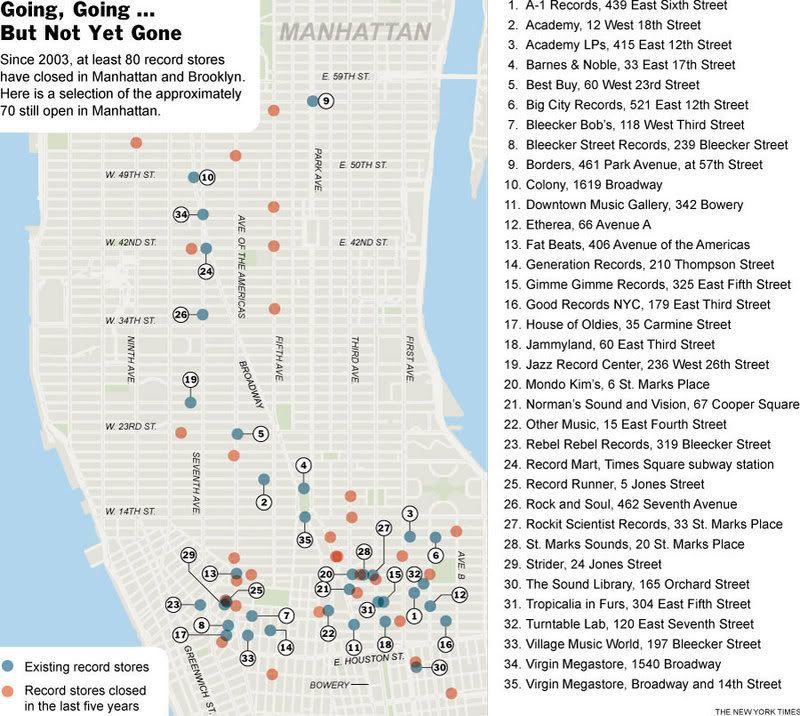
Following my earlier posts and the map that ran in the Times, here’s my first foray into customized Google Maps: a fuller plotting of Manhattan’s record stores, past and present.

Blue markers represent stores that are open; red means closed; yellow is status unknown (mostly because I haven’t gotten around to making the latest batch of phone calls); purple means it’s a non-record store that has a significant music section. Like the list I have been updating — with extra details including the date each red one closed — I want to make this as complete and accurate as possible, so additions, corrections and news are all welcome.


View Larger Map

Last updated: September 2009

Wednesday, April 23, 2008

The death and life of great Manhattan record stores

Second update to my story last week about the disappearing record stores of New York City (and the survivors’ efforts to stay in business).

As I said before, some stores were left out, mostly for the usual journalistic reasons: tight space, redundancy, difficulty confirming facts on deadline. Since the piece ran I’ve been contacted by a number of people about omissions, and while most of those stores I had already known about, some of them I hadn’t.

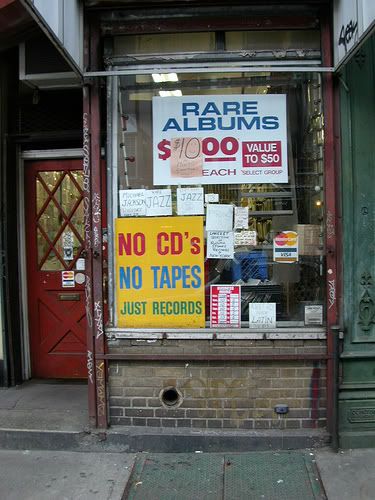
So in the spirit of bloggy completeness, here are all the record stores I’m aware of, each confirmed by phone, visit or reliable source. All the stores in Manhattan, that is. Brooklyn is a whole other can of worms.


I. Open

There are at least 44 39 shops in Manhattan whose primary business is selling CDs and/or records; assuming I have been able to pin down 90 percent of them, the full number might be somewhere around 50 45. I hope to get them all here:

Photobucket

Other stores that have significant record sections (thrift shops with 100 dusty Mantovani and Ohio Players LPs don’t count):

Big Boxes with significant music sections:

  • Barnes & Noble, 97 Warren Street
  • Barnes & Noble, 33 East 17th Street
  • Barnes & Noble, 160 East 54th Street
  • Barnes & Noble, 555 Fifth Avenue, at 46th Street
  • Barnes & Noble, 1972 Broadway, at 66th Street
  • Best Buy, 60 West 23rd Street
  • Best Buy, 1280 Lexington Avenue, at 86th Street
  • Borders, 100 Broadway, at Pine Street
  • Borders, 2 Penn Plaza (33rd Street & Seventh Avenue)
  • Borders, 576 Second Avenue, at 32nd Street
  • Borders, 461 Park Avenue, at 57th Street
  • Borders, 10 Columbus Circle

Big boxes that do not have significant music sections:

  • Barnes & Noble, Broadway at 82nd Street
  • Barnes & Noble, 86th Street and Second Avenue


Photobucket

(Updated and much more thorough map here.)


II. Dunno

Big boxes that I don’t know about because I’m tired of calling and visiting big boxes:

  • Best Buy, 529 Fifth Avenue
  • Best Buy, 622 Broadway
  • Best Buy, 1880 Broadway
  • Circuit City, 232 East 86th Street
  • Circuit City, 521 Fifth Avenue
  • Circuit City, 52 East 14th Street
  • Circuit City, 2232 Broadway

Not sure if this one counts:

  • InMotion Entertainment, Grand Central Station

Status unclear, any info welcome:

  • Discomania, 3883 Broadway, at 162nd Street (open but with liquidation sign up 8/24/08)
  • Discorama Annex, 40 Union Square East (been closed every time I go by there)
  • Bondy’s, 38 Park Row
  • African Movies and Music, 1265 Broadway, Room 600, at 32nd Street (here’s a YouTube tour! though I haven’t been there to confirm)
  • Samassa Records, 1225 Broadway, Suite 319, at 30th Street (comments on YouTube tour above suggest it’s closed)
  • Audio Video Interactive, 915 Broadway
  • NY Music, 151 Canal Street (J-pop?)
  • Always Buying Records, 325 East Fifth Street
  • El Ra, 215 West 101st Street (this appears to be just an apartment building)
  • La Pachanga, 2149 Third Avenue
  • Satellite, 259 Bowery

III. Closed

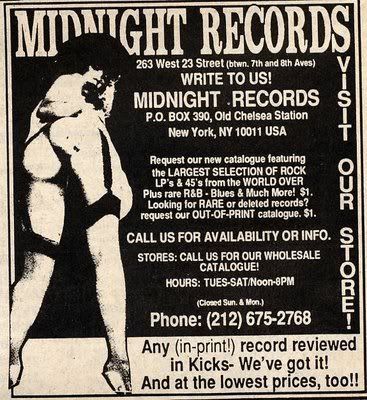
Here are stores that I can confirm are kaput. Most have closed in the last five years; those are noted in red on the map. (Some stores have continued online, such as Midnight Records.) For purely historical/nerdy reasons I am also including many shops that may have closed long ago.

Photobucket
  • A Classical Record, 547 West 27th Street (owner, Albert ten Brink, passed away 7/08; for a while after closing store, he continued to sell by appointment out of a storage unit)
  • Accidental CDs, 131 Avenue A, near St. Marks Place (closed 7/06)
  • Adult Crash, 66 Avenue A, between Fourth and Fifth Streets (lease taken over in 1998 or 1999 by Etherea, below)
  • Barnes & Noble, 675 Avenue of the Americas, between 21st and 22nd Streets (closed abruptly 3/31/08)
  • Bate, 140 Delancey Street
  • Bobby’s Happy House, 2335 Frederick Douglass Boulevard, at 125th Street (closed 1/21/08)
  • BPM, 334 Bleecker Street (electronica)
  • Breakbeat Science, 181 Orchard Street
  • Cool Runnin’, 73 Second Avenue (reggae; had been open in 1984)
  • Culture Records, 31 Carmine Street (reggae; apparently had been open in 1995)
  • Dance Tracks, 91 East Third Street (closed 11/07)
  • Decadance Inc., 119 Christopher Street (electronica)
  • Downstairs Records, 1026 Avenue of the Americas, between 38th and 39th Streets (closed 11/04; moved to Copiague, N.Y.; had once been at 35 West 43rd Street)
  • Dub Spot, 437 East 12th Street (closed within two years of 2003; is it associated with the Dubspot DJ school?)
  • Eightball Records (a.k.a. The Shop), 105 East Ninth Street (closed 1/22/04)
  • Entertainment Warehouse, 835 Broadway, at 13th Street (long gone; it was open in 1996 — when did it close?)
  • Etherea, 66 Avenue A, between Fourth and Fifth Streets (closed 2/09; took over lease from Adult Crash in 1998 or 1999)
  • Finyl Vinyl, 208 East Sixth Street (closed 12/07)
  • Footlight Records, 113 East 12th Street (apparently closed 8/28/05)
  • Future Legend, 796 Ninth Avenue, at 53rd Street (closed 2/08)
  • FYE, 1290 Avenue of the Americas, at 52nd Street (closed 11/06)
  • FYE, 390 Avenue of the Americas, near Waverly Place (closed 1/05; had been a Sam Goody)
  • Galaxy, 3633 Broadway, at 150th Street
  • Harlem Music House, 567 West 125th Street (closed 11/10/05)
  • Harlem Record Shack, 274 West 125th Street (evicted 7/08, now sells CDs on the street)
  • Heartbeat Records, 107 West 10th Street (closed 11/30/04)
  • HMV, 234 West 42nd Street (closed 4/04)
  • HMV, 308 West 125th Street (closed 5/15/04)
  • HMV, 565 Fifth Avenue, between 46th and 47th Streets (closed 12/04)
  • Jammyland, 60 East Third Street
  • Joe’s CDs, 13 St. Marks Place (closed 6/06)
  • Kappy’s, 91 Pinehurst Avenue, at 181st Street (closed 5/10/04)
  • Kim’s Mediapolis, 2906 Broadway, near 113th Street (opened “late April” 2001, closed 9/15/08; now a Ricky’s)
  • Kim’s Underground, 144 Bleecker Street (How long gone? I’d guess it closed circa 2004-05. It became a Duane Reade.)
  • Kim’s West, 350 Bleecker Street (long gone)
  • Los Amigos, 3444 Broadway, near 141st Street (closed 12/07)
  • Midnight Records, 255 West 23rd Street (closed 3/6/04)
  • 99 Records, 99 Macdougal Street (No Wave landmark, closed in the mid-’80s; some info here; MySpace tribute here)
  • Nostalgia, 217 Thompson Street (jazz)
  • NYCD, 426 Amsterdam Avenue, near 80th Street (store closed 12/25/05; online operation closed 7/07)
  • Rainbow Music Shop, 102 West 125th Street (closed 01/09/04)
  • Record Explosion, 384 Fifth Avenue, near 36th Street (closed 8/04)
  • Record Explosion, 507 Fifth Avenue, near 42nd Street (closed 5/06)
  • Records Revisited, 34 West 33rd Street, room 214 (closed in 2006)
  • Revolver Records, 45 West Eighth Street (had been open at least until 2005)
  • Rocks in Your Head, 157 Prince Street (moved to Brooklyn 5/1/06, then closed — when?)
  • Route 66 Records, 258 Bleecker Street, at Carmine Street (had been there as of at least 1/99 [per old receipt of mine]; at some point moved to 99 Macdougal, then closed — when?)
  • Santo Domingo, 4323 Broadway, near 185th Street (closed 12/07)
  • Second Coming, 235 Sullivan Street (long gone; was raided for bootlegs in 1996)
  • Shrine, 441 East Ninth Street (I think I remember Mark Ibold from Pavement working here; or perhaps it was Strange?, two doors to the east)
  • Smash Discs, 33 St. Marks Place
  • Sonic Groove, 206 Avenue B, near 13th Street (closed 5/28/04)
  • Sound and Fury, 192 Orchard Street (Anyone know when this closed? I remember almost buying a vinyl copy of Oneida’s “Each One Teach One” there, which was 2002 — really regret not getting it, BTW, the handwritten burn I have just ain’t the same)
  • Sounds, 16 St. Marks Place (closed 1/04)
  • STMARX, 80 East 10th Street (closed recently?)
  • Stooz Records, 122 East Seventh Street
  • Strange?, 445 East Ninth Street (long gone)
  • Subterranean Records, 5 Cornelia Street (at least no longer at its longtime address — can anyone confirm that it has closed and not moved?)
  • Temple Records, 29A Avenue B (or was it inside Liquid Sky at 241 Lafayette Street?) (closed within two years of 2003)
  • Throb, 211 East 14th Street (closed 10/31/03)
  • Tompkins Square Bookstore, 115 East Seventh Street (carried a lot of used vinyl; it was a mess but it was a cool place)
  • Tower Records, 721-725 Fifth Avenue, between 56th and 57th Streets
  • Tower Records, Broadway at 66th Street (closed 12/06)
  • Tower Records, Broadway at East Fourth Street (opened 1983, closed 12/06)
  • Tribal Soundz, 340 East Sixth Street, a funky little store with exotic musical instruments (I met Damian, master of the pan flute, here in 2004) and some CDs, shut down recently, details mysterious
  • Triton, 247 Bleecker Street
  • Venus, 13 St. Marks Place (long gone, right? anybody know when they closed?)
  • Vinylmania, 60 Carmine Street (closed 3/17/07)
  • Vinyl Market, 241 East 10th Street (must have closed pretty recently; there were still boxes lying around when I peeked in couple of weeks ago)
  • Virgin Megastore, Times Square, 1540 Broadway, at 45th Street
  • Virgin Megastore, Union Square, Broadway and 14th Street
  • Wowsville, 125 Second Avenue, near St. Marks Place (closed 2/05)
  • Zapp Records, 258 Bleecker Street

Need confirmation/details:

  • Two Record Factory stores, at 17 West Eighth Street and 108 East 23rd Street (they were open in 1984)
  • Two Vinylmania stores: 52 Carmine Street (disco) and 30 Carmine Street (rock) (1984)
  • King Karol, 126 West 42nd Street (was open as of 1984; also had a jazz shop at 33 Park Row)
  • 96 Music (or Ninety-Six Music?), formerly Joe’s CDs West, 96 Christopher Street, possibly closed 4/07
  • Proud A Ras, 119 East Seventh Street, supposedly a tiny reggae shop
  • Free Being, 129 Second Avenue, at St. Marks Place (1984)
  • Downtown Music West, 57 Leroy Street (“satellite store of the original Downtown Music Gallery ... specializes in vinyl singles of dance music from the 1970s onward, but also carries its fair share of avant-garde music by local composers, jazz, blues and alternative rock,” NYT 1994)
  • Watu Records, 41 Carmine Street (reggae)
  • Citidisc, 2264 Broadway, near 81st Street, was an early all-CD shop
  • Orpheus Remarkable Recordings, 1047 Lexington Avenue, at 76th Street (1984)
  • Barry’s Stereo & Sound, 119 (or 111?) East 23rd Street (was open in 1984)
  • Beyond Bass, 60 East Third Street (according to this, it is/was an electronic shop with some assocation to DJ Danny “Buddah” Morales)
  • Delirium Records, 382 West Broadway (according to some guy in 1995)
  • Darton Records, in the back room of Patelson’s sheet-music store, 160 West 56th Street (1984)
  • Music Masters, 25 West 43rd Street (1984)
  • Dayton’s, 824 Broadway (1984)
  • Infinite, 208 Mercer Street (1984)
  • Pyramid Records, 201 Seventh Avenue, near 21st Street (1984)
  • Jimmy’s Music World, 400 Fifth Avenue, at 37th Street (1984)
  • Stackhouse, somewhere in 10012, closed 5/07
  • Star Music, somewhere in 10002, closed 3/08
  • A few Sam Goody’s stores, closed by end of 2003 (there was once one at 1011 Third Avenue, at 60th Street; I believe the former FYE on 6th Ave in the Village used to be a Sam Sam Goody’s — anyone remember the others?)
  • SoHo Music Gallery, 26 Wooster Street, at Grand Street (1984)
  • Music Inn, 169 West Fourth Street (1984)
  • Village Jazz Shop, 163 West 10th Street (“a comfortable, down-home room with sporadic hours and a vast collection of jazz CDs,” NYT 1994)
  • The Zone, somewhere in 10001, said to have closed 5/04

More:

  • A page with info on dead stores


Updates, corrections and any other relevant information is appreciated, and will be incorporated here. Viva la vinyl.

Last updated: September 2009

Sunday, April 13, 2008

The Tale of the Black Freighter

I may be a sucker for all this early Watchmen hype, but I don’t care.

The Boredom Festival has an impressive reconstruction of “Tales of the Black Freighter,” the grisly comic-within-a-comic in Watchmen. It’s an excellent example of Alan Moore and Dave Gibbons’s multilayered storytelling style, and it’s a great story to boot. In it, “Black Freighter” panels alternate with scenes of New York in 1985, where a boy reads the vintage-E.C.-style pirate book at a newsstand. (On the corner of 40th and Seventh — lemme hear it for my nerds.) Reflecting multiple threads of the larger “Watchmen” narrative and foreshadowing the bloody climax, it’s also a tribute to the comic form itself.

Here’s what it looks like. The round word balloons are for “real life,” the scrolled text for “Black Freighter”:
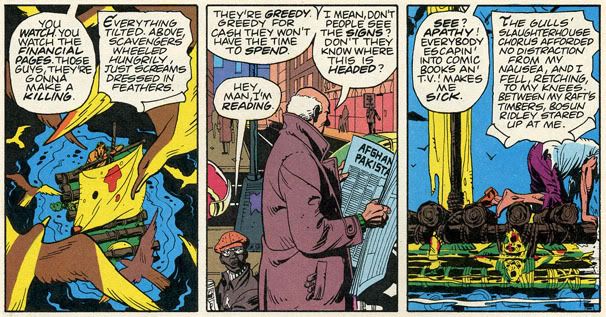
Black Freighter

Evidently with some time on his hands, the Boredom blogger isolated the pirate story by scanning every page on which its panels appear and eliminating all non-“Black Freighter” art and text, then consolidating the panels to form one continuous 20-page book. (In the original, the “Black Freighter” story is interspersed between Chapters 3 and 11.) The resulting pages look like this:
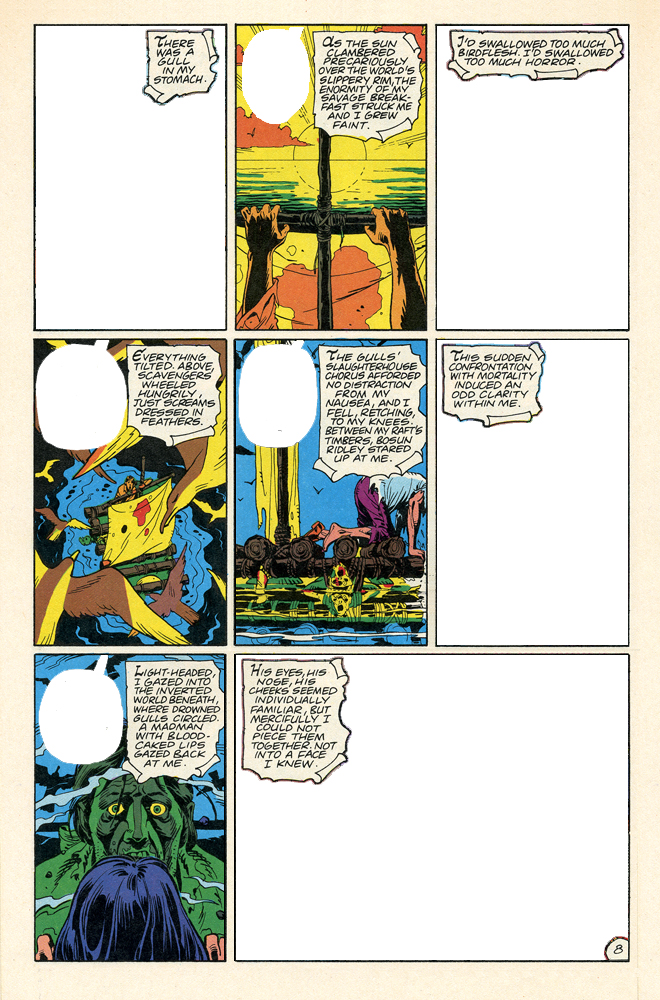
157710020_a83366e95e_o

The pirate story isn’t hard to follow in the original, but this brings it to the forefront and removes all possibility of distraction. The plot is brutally concise: Shipwrecked castaway races phantom pirate ship home, riding a raft made from corpses (and fending off sharks along the way); ashore, thinks pirates arrived first and goes on mad killing spree to reach family; realizing mistake, accepts his damnation.

The clever thing is that pirate stories were never a major part of comics’ Golden Age. Superheroes, horror and sci-fi were the dominant genres, at least in the action/young-male category. (Romance titles were also huge, but never developed the same tradition or literary weight.) As explained at the end of Chapter 5 in a fictitious comics history, Moore and Gibbons’s idea was that kids in this alternate 1985 would not have been interested in masked vigilantes because those characters were already a part of real life, and in fact were sanctioned by the government. Rather, young readers preferred the world of pirates, a moral vacuum of criminality and murder in which authority figures were largely absent.

Gruesome fatalism sets the tone for the late-Cold War society depicted in Watchmen. The black pirate sails match the black-on-yellow triangles of the ubiquitous fallout shelter signs, and in both cases there’s no hope of survival. The fallout shelters, of course, offer no real sanctuary from war: people are going to die when the bombs drop, just as the poor schmuck in “Black Freighter” has no way out once the black sails arrive. And the one-man-against-the-world theme satisfies a desire to both escape from civilization and dominate it — like Adrian Veidt in his fortress in Antarctica, and Dr. Manhattan in his on Mars.

Last month David Hajdu, who has written books about Billy Strayhorn and the Dylan-Baez-Fariña-Fariña folk/love/BS quadrangle, published The Ten-Cent Plague: The Great Comic-Book Scare and How It Changed America, about the public crackdown on comics in the 1950s. I haven’t read it yet, but it’s been getting good reviews, and I’ve always considered this an important topic that has never been sufficiently explored. The comics scare was a low-culture reflection of the witch-hunts that were already claiming intellectuals and entertainment figures, with dubious experts like the psychiatrist Fredric Wertham testifying in Congress about how violent comics were corrupting our youth. Among his many absurd and inflammatory quotes: “Hitler was a beginner compared to the comic book industry.”

“Black Freighter” is a 100-proof distillation of what so frightened Dr. Wertham. Besides its graphic violence, besides its themes of slaughtered innocents and last survivors bound for hell, the language itself is merciless, with gross and appropriately turgid lines like: “I’d swallowed too much birdflesh. I’d swallowed too much horror.” That’s both a homage to the gore and melodrama of E.C. and an illustration of how cruel the Watchmen society had become. Horror comics, and life in general, just kept getting more dreadful, increasingly focused on war and extinction. Even the salvation Veidt seeks is still mass murder.

In Chapter 5’s fake history, it’s explained that the government stepped in during the ’50s crackdown and protected comic book publishers, since superhero-like figures were on the federal payroll:

With the government of the day coming down squarely on the side of the comic books in an effort to protect the image of certain comic book-inspired agents in their employ, it was as if the comic industry had suddenly been given the blessing of Uncle Sam himself — or at least J. Edgar Hoover.

So comics never got censored or homogenized, never forced underground. And the publishers — who in the real 1950s were selling 80 to 100 million books a week — never lost their grip on youth culture. In fact they might have made things worse for the society at large, by becoming a de facto propaganda machine: the destruction that Dr. Manhattan and the Comedian wrought on Vietnam and elsewhere could be justified — and Nixon could elected for four terms — precisely because all-American comic book heroes were involved.

This is the genius of Watchmen. More than any other book — especially during the 1980s, the heyday of literary comics — it drew vivid and frighteningly plausible connections between reality and fantasy, and used the mythology of comics to explain the psychology and politics of its time. (Remember, this was still very much the era of Russkies, the Berlin Wall and Chernobyl.) That’s the highest achievement any book of any kind can hope for.

The movie will suck. That’s pretty much a given. (The director, Zack Snyder, has already said he’s going to soften the ending. Need another reason? “Tales of the Black Freighter” will not be part of the movie, though it will be on the DVD release — hey, it’s not an important part of the story, after all, just a carrot to entice retail sales.) But any opportunity to revisit the book is welcome. It’s more brilliant every time I read it.
Monday, December 24, 2007

WPIX Yule Log for iPod

Photobucket

The historic WPIX Yule Log, that is. Download here.